
The Desert Ecosystem
10/02/2008 16:31
Temperature of the Desert- The four major North American deserts of this type are the Chihuahuan, Sonoran, Mojave and Great Basin. Others outside the U.S. include the Southern Asian realm, Neotropical (South and Central America), Ethiopian (Africa) and Australian. The seasons are generally warm throughout the year and very hot in the summer. The winters usually bring little rainfall.
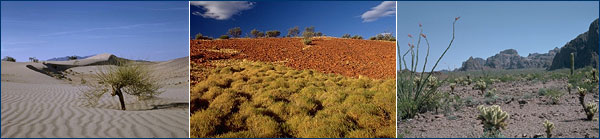
From left: Baja, Mexico desert; desert in Uluru National Park, Australia; desert near the Kofa Mountains, Arizona.
Temperatures exhibit daily extremes because the atmosphere contains little humidity to block the Sun's rays. Desert surfaces receive a little more than twice the solar radiation received by humid regions and lose almost twice as much heat at night. Many mean annual temperatures range from 20-25° C. The extreme maximum ranges from 43.5-49° C. Minimum temperatures sometimes drop to -18° C.
Rainfall is usually very low and/or concentrated in short bursts between long rainless periods. Evaporation rates regularly exceed rainfall rates. Sometimes rain starts falling and evaporates before reaching the ground. Rainfall is lowest on the Atacama Desert of Chile, where it averages less than 1.5 cm. Some years are even rainless. Inland Sahara also receives less than 1.5 cm a year. Rainfall in American deserts is higher — almost 28 cm a year.
Soils are course-textured, shallow, rocky or gravely with good drainage and have no subsurface water. They are coarse because there is less chemical weathering. The finer dust and sand particles are blown elsewhere, leaving heavier pieces behind.
Canopy in most deserts is very rare. Plants are mainly ground-hugging shrubs and short woody trees. Leaves are "replete" (fully supported with nutrients) with water-conserving characteristics. They tend to be small, thick and covered with a thick cuticle (outer layer). In the cacti, the leaves are much-reduced (to spines) and photosynthetic activity is restricted to the stems. Some plants open their stomata (microscopic openings in the epidermis of leaves that allow for gas exchange) only at night when evaporation rates are lowest. These plants include: yuccas, ocotillo, turpentine bush, prickly pears, false mesquite, sotol, ephedras, agaves and brittlebush.
The animals include small nocturnal (active at night) carnivores. The dominant animals are burrowers and kangaroo rats. There are also insects, arachnids, reptiles and birds. The animals stay inactive in protected hideaways during the hot day and come out to forage at dusk, dawn or at night, when the desert is cooler.
Semiarid desert
The major deserts of this type include the sagebrush of Utah, Montana and Great Basin. They also include the Nearctic realm (North America, Newfoundland, Greenland, Russia, Europe and northern Asia).
The summers are moderately long and dry, and like hot deserts, the winters normally bring low concentrations of rainfall. Summer temperatures usually average between 21-27° C. It normally does not go above 38° C and evening temperatures are cool, at around 10° C. Cool nights help both plants and animals by reducing moisture loss from transpiration, sweating and breathing. Furthermore, condensation of dew caused by night cooling may equal or exceed the rainfall received by some deserts. As in the hot desert, rainfall is often very low and/or concentrated. The average rainfall ranges from 2-4 cm annually.
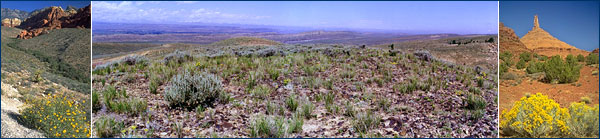 From left: Red Rock Canyon National Conservation Area, southern Nevada; sagebrush near Bridger, Montana; Castle Valley, Utah, east of Arches National Park. |
The soil can range from sandy and fine-textured to loose rock fragments, gravel or sand. It has a fairly low salt concentration, compared to deserts which receive a lot of rain (acquiring higher salt concentrations as a result). In areas such as mountain slopes, the soil is shallow, rocky or gravely with good drainage. In the upper bajada (lower slopes) they are coarse-textured, rocky, well-drained and partly "laid by rock bench." In the lower bajada (bottom land) the soil is sandy and fine-textured, often with "caliche hardpan." In each case there is no subsurface water.
The spiny nature of many plants in semiarid deserts provides protection in a hazardous environment. The large numbers of spines shade the surface enough to significantly reduce transpiration. The same may be true of the hairs on the woolly desert plants. Many plants have silvery or glossy leaves, allowing them to reflect more radiant energy. These plants often have an unfavorable odor or taste. Semiarid plants include: Creosote bush, bur sage (Franseria dumosa or F. deltoidea), white thorn, cat claw, mesquite, brittle bushes (Encelia farinosa), lyciums, and jujube.
During the day, insects move around twigs to stay on the shady side; jack rabbits follow the moving shadow of a cactus or shrub. Naturally, many animals find protection in underground burrows where they are insulated from both heat and aridity. These animals include mammals such as the kangaroo rats, rabbits, and skunks; insects like grasshoppers and ants; reptiles are represented by lizards and snakes; and birds such as burrowing owls and the California thrasher. https://www.ucmp.berkeley.edu/exhibits/biomes/deserts.php,
Top photo by David K. Smith, UCMP; Hot and dry desert photos, from left: Glenn and Martha Vargas © 2004 California Academy of Sciences; Gerald and Buff Corsi © 2002 California Academy of Sciences; Glenn and Martha Vargas © 2004 California Academy of Sciences. Semiarid desert photos, from left: Gerald and Buff Corsi © 2000 California Academy of Sciences; David K. Smith, UCMP; Gerald and Buff Corsi © 2000 California Academy of Sciences. Cold desert photos, from left: Gerald and Buff Corsi © 2004 California Academy of Sciences; Dr. Lloyd Glenn Ingles © 1999 California Academy of Sciences.
Biotic and Abiotic Components- Biotic Factors
Biotic, meaning of or related to life, are living factors. Plants, animals, fungi, protist and bacteria are all biotic or living factors
Abiotic Factors
Abiotic, meaning not alive, are nonliving factors that affect living organisms. Environmental factors such habitat (pond, lake, ocean, desert, mountain) or weather such as temperature, cloud cover, rain, snow, hurricanes, etc. are abiotic factors.
Biotic factors are, in entirety, anything that affects a living organism that is itself alive. Such things include animals which consume the organism in question, or the food that the organism consumes. As opposed to abiotic factors (non-living components of an organism's environment, such as temperature, light, moisture, air currents, etc.), biotic factors are the living components of an organisms environment, such as predators and prey.
For example, if one were to examine a desert ecosystem for biotic and abiotic factors, one would observe things like the extreme temperatures of the day and night, the fast winds, the heavy amount of sunlight, and scarcity of water as abiotic, or NON-living factors in the environment. One would observe that for a quail living in the desert, living elements like the quail's prey (insects, seeds, etc.) and predators (coyotes, sparrow hawk, gold eagles, etc.) make up the biotic factors of the quail's environment.
https://answers.yahoo.com/question/index?qid=20071112181207AAxdCAB,
Copyright © 2008 Yahoo! Inc. All Rights Reserved.
Food Chain- Typical Desert Food Pyramid
Tertiary Consumers
Carnivores
These are high level consumers, carnivores that will eat other carnivores.
3rd Trophic Level:
Secondary Consumers
Small Carnivores
The predators are the secondary consumers. They occupy the third trophic level. Again we see cold-blooded animals, such as snakes, insect-eating lizards, and tarantualas. Only about 2 Kilocalories per square meter per year are stored in their bodies. In the harsher desert environments, they are the top predators.
2nd Trophic Level:
Primary Consumers
Herbivores
These animals are usually small and eat little. Many are insects, or reptiles, who are cold blooded and who use less energy to maintain their bodies than mammals and birds do. As food for predators, they provide about 20 Kilocalories per square meter per year for predators.
Including:
Ants and other insects, rats and mice, some reptiles the largest of which are the tortoise and chuckwalla.
1st Trophic Level:
Primary Producers
Plants
These are plants that make food through photosynthesis. Limited by the availability of water, they produce fewer than 200 Kilocalories of food for the animals for each square meter each year.
Including:
Trees, shrubs, cactus, wildflowers, grasses
Primary Producers
Food chains are divided into nutritional or trophic levels. The first trophic, or lowest level, is occupied by the primary producers, plants.
Plants produce energy from photosynthesis. Plants produce energy to use for survival, growth and to store when production resources are not available. The amount of energy produced is measured in kilocalories and limited by the availability of sunlight, water and nutritional resources available to the plant. In the desert biome water is the determining resource. In an environment where water is readily available (such as an oasis, spring or desert riparian biomes) more plant diversity is available and more kilocalories of energy are produced. In a sparse, dry ecosystem, where plants can not survive unless widely spaced, only about 200 kilocalories of food per square meter per year are produced.
Primary Consumers
Primary consumers are the animals that eat the plants. These animals, including insects, occupy the second trophic level. Energy is tranferred from the plants to the consumers as food for the consumers. Although primary consumers are for the most part herbivorious, this is where the line between the primary and secondary consumers begins to blur.
In a mammal, such as the desert pocket mouse, food is consumed and converted to energy. The mouse, being warm-blooded, uses this energy in several ways.
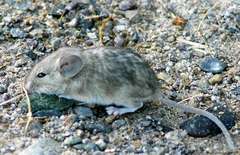
- 1. The mouse recieves stored energy by eating food.
2. The mouse's metabolism converts stored energy from the food to available energy for it's survival. To survive the mouse needs to grow, acquire more food, escape predators, etc). Some energy is lost to heat, but this heat can be helpful to keep the mouse's body at a normal temperature in cold weather.
3. Some energy is lost in the production and passing of waste as unprocessed nutrients.
4. About 90% of the energy the mouse converts from food is stored and used by the mouse. The remaining 10% is available for consumption by predators at the next trophic level.
Secondary Consumers - Small Predators
Tertiary Consumers - Large Predators
https://digital-desert.com/wildlife/food-chains/, Copyright ©Walter Feller. All rights reserved.
Respect U.S and international copyright statutes and our right to own and control our work
Pollution and Pesticides- There are four sorts of polluted land:
- Places where gas works, oil refineries, oil storage depots nuclear power stations and chemical factories have been built
- Refuse dumps where domestic and industrial waste are deposited
- Agricultural land where modern farming methods have been practised
- The rest of the world’s land surface
The fourth type of polluted land results from phenomena such as “acid rain”. Quantities deposited at a time are very small, but because the materials are so persistent the effect is cumulative over many years. Often the effect is not visible for a long time, then there is a sudden decline in the health of the ecosystem and a near-desert results.
https://members.aol.com/planetwise/soil.htm, © June 1997 The Cat Survival Trust, The Centre, Codicote Road, Welwyn, AL6 9TU, England. Latest update: 27th March, 1998
———
Back